How to Launch a Product or Service (and What a “Launch” Actually Means)
What does it actually mean to launch something in your business? Because hitting “publish” on your website isn’t necessarily a launch. Adding a new product to your Etsy shop isn’t necessarily a launch either.
A launch is more like an event.
There’s a little runway leading up to it. You tell people what’s coming. You build interest. You invite people to take action. And usually, there’s some kind of deadline involved.
In this episode of Mugs & Marketing, we’re chatting about what a launch actually looks like behind the scenes – and we’re doing it while Ashley is smack dab in the middle of launching her newest program, Fill the Grid.
Alisha, meanwhile, realizes she may have a unicorn mug launch in her future. 🦄
So grab your coffee. Let’s talk launches.
Publishing vs. Launching: What’s the Difference?
Let’s start with one of the biggest distinctions from this episode.
Publishing means you made something available.
You published your website, added a product to your shop or put your new membership on your website.
Done!
A launch involves actively inviting people into that thing.
Maybe you:
- Build a waitlist
- Share behind-the-scenes content
- Send emails
- Host a free workshop or challenge
- Talk about the problem your offer solves
- Open enrollment
- Give people a real deadline to join
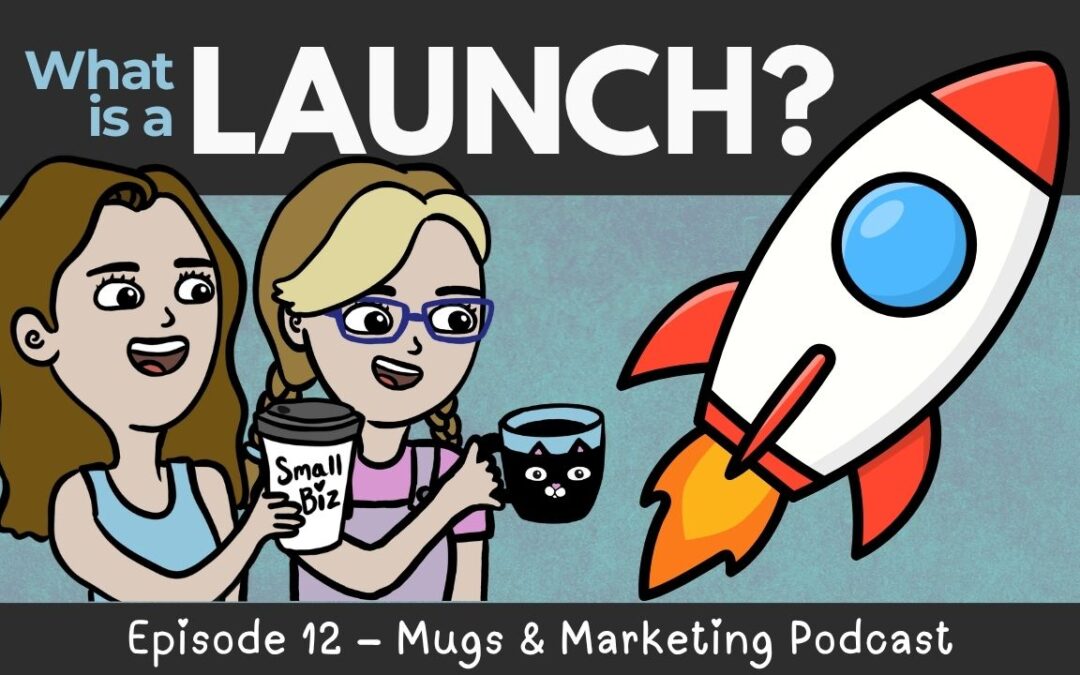
Think of it like launching a rocket. There’s a whole countdown before the rocket actually leaves the ground.
Start Talking About It Before It’s Ready
This is something Ashley has learned over years of launching digital products:
Don’t wait until everything is finished before you tell people about it.
If you spend three months quietly creating the perfect course, class, membership, pottery collection, or workshop and then announce it… You may discover nobody was waiting for it. Yikes!
Instead, start sharing early. You don’t need the entire thing finished.
You can talk about:
- What you’re creating
- Why you’re creating it
- Who it’s for
- The problem you’re trying to solve
- Your behind-the-scenes process
- What you’re learning along the way
You can also create a waitlist so interested people have somewhere to raise their hand and say: “Hey! Tell me when this is ready.”
How Much Time Should You Give Yourself?
There’s no perfect launch timeline, but Ashley recommends thinking bigger than a few days. If you’re starting without an existing audience for your offer, giving yourself around four to six weeks to build interest can be helpful.
That doesn’t mean four to six weeks of yelling: BUY MY THING!!!
Please don’t do that. 😂
The beginning can be much quieter. Share relevant content. Mention what’s coming. Build your waitlist. Create the behind-the-scenes pieces.
Then, as the actual launch gets closer, your promotion becomes more focused.
Launching Physical Products Counts Too
This conversation isn’t just for online course creators. Alisha sells handmade pottery, and we talked about how these same ideas could apply to a product drop.
Instead of: “Hey! I made some unicorn mugs. They’re available now.”
She could spend a few weeks sharing:
- 🦄 The first prototypes
- 🦄 Behind-the-scenes videos
- 🦄 Different designs and techniques
- 🦄 Sneak peeks
- 🦄 The date the collection will become available
Now people aren’t discovering the mugs for the first time when they’re available to buy. They’ve been watching them come to life.
Alisha also realized she’d already done a version of a launch with her Paint Your Own Cat Mug workshop. She set a date, promoted it ahead of time, emailed her audience, shared that spots were limited, and ultimately filled eight of the ten available spots. That counts!
Launches Can Be Exhausting
Here’s the part we don’t always talk about. Launching can take a LOT of energy.
Ashley shared how some of her early launches left her completely depleted. After several days of teaching, promoting, answering questions, and showing up constantly, she’d sometimes lose her voice or get sick afterward.
Eventually, she realized something had to change. For a more recent launch, she intentionally decided:
I’m going to have fun with this.
She lowered some of her expectations, stopped trying to overachieve every little detail, and focused on enjoying the experience.
And guess what? She didn’t get sick afterward. There’s probably a lesson in there. 😉
What Happens When a Launch Flops?
Sometimes you launch something… and crickets.
Or maybe you make a few sales, but nowhere near the goal you’d set.
That doesn’t necessarily mean your product is bad.
A launch can underperform for all kinds of reasons:
- Not enough people saw it
- Your messaging wasn’t clear
- The signup process was confusing
- The offer didn’t match the free content
- You didn’t promote it enough
- You gave up halfway through
- The timing simply wasn’t right
That’s why a launch debrief can be so valuable. Afterward, look at what happened.
- How many people saw your offer?
- How many joined the waitlist?
- How many registered for the free event?
- How many bought?
- Where did people drop off?
Instead of saying, “Well, that failed,” you can ask: “What did this teach me?”
The First Launch Is a Test
One reason not to create every tiny detail before your first launch is that you don’t know how people will respond yet. Your first launch gives you information.
Ashley shared that after running her Video Creation Camp more than once, she discovered that around 6.5% of people who registered for the free event went on to buy her YouTube course.
Now she has real data she can use when planning future launches. But she couldn’t have known that before doing it the first time. Sometimes you have to try the thing before you can optimize the thing.
Why Not Leave Everything Open All the Time?
If people can buy whenever they want…
They often wait. And wait. And wait some more.
A real deadline gives someone a reason to make a decision.
Ashley shared the story of a beloved Armenian bakery that was only open on Saturday mornings until they sold out. People lined up before it even opened. The limited availability made Saturday morning feel like an event.
The same principle can apply to a business launch.
That doesn’t mean creating fake urgency or pretending something is disappearing forever when it isn’t. Real deadlines are useful. Fake scarcity is icky. If you say enrollment closes Friday, let it close Friday.
You Don’t Need to Launch Every Month
Launching requires energy. So you probably don’t want to be in launch mode 24/7.
Ashley suggests thinking in quarters and doing no more than roughly four larger launches per year. That could mean launching the same offer several times.
Or maybe your business has different seasonal offers.
The space between launches gives you time to serve your existing customers, create your products, teach your classes, and – ya know – have a life.
Your Launch Doesn’t Have to Be Perfect
This might be the biggest reminder Ashley needed herself during this episode. You don’t have to go above and beyond on everything. Your sales page doesn’t need another seventeen sections. Your free training doesn’t need three additional bonuses. Your graphics don’t need another four hours of tweaking.
Sometimes…
Good enough really is good enough.
Launch it and see what happens.
Look at the numbers and learn from then
And then make the next one better.
That’s how creative businesses grow.
Resources Mentioned in This Episode
- 📌 Fill the Grid
- 📌 Alisha’s Pottery + Unicorn Mugs
- 📌 Google Analytics
- 📌 OfferingTree
- 📌 Video Creation Camp Waitlist
- 📌 Mugs & Marketing Coffee Club
Affiliate disclaimer: Some links shared in this post may be affiliate links, which means we may earn a small commission if you make a purchase—at no extra cost to you.